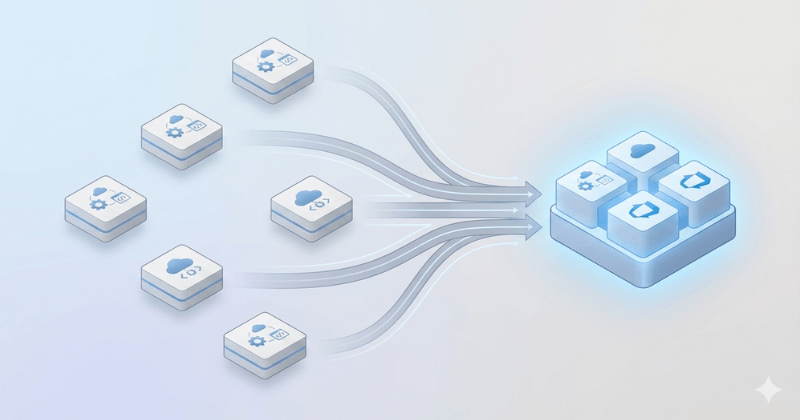
According to industry analysts, 60–90% of cloud migration projects fall short of their goals, often due to predictable, recurring issues rather than rare technical errors. But most of these Azure DevOps migration issues are entirely avoidable.
With the right awareness and preparation, enterprises can steer clear of costly missteps and accelerate their path to the substantial efficiency, scalability, and governance benefits that a well-executed Azure DevOps migration delivers.
If your enterprise is undertaking an Azure DevOps migration, then read on as we list some of these common challenges along with the best practices to avoid them.
Pitfall #1 – Ignoring Process Template Differences
Azure DevOps supports multiple process models — Inherited and Hosted XML — with differing definitions for work item types and workflows. If data is moved from one Azure DevOps project to another without checking whether both use the same form structure/template, things will break.
Mitigation
The solution for a smooth Azure DevOps migration issues is to take an inventory of the process templates standardize the names and types of work items so they align across environments. Mapping tools can be used to correctly translate each work item type from the old system to the new one.
Pitfall #2 - Losing Work Item History or Attachments
Data loss is a frequent and high-risk challenge when you migrate Azure DevOps attachments. Incomplete history or missing attachments can lead to errors in audit trails, approvals, and future compliance issues. Even sophisticated tools have limits: Azure DevOps’ TFS Attachment Tool shows that attachments beyond certain size limits (e.g., >60 MB in Azure DevOps Services) can fail silently unless handled explicitly.
Mitigation
To avoid losing work item history or attachments during migration, it’s important to use dedicated, purpose-built migration tools that are designed to handle these elements reliably rather than relying on manual exports or basic scripts.
After the migration, you should always run thorough validation to confirm everything transferred correctly. This includes checking that the number of revisions, comments, and attachments in the target system matches what you had in the source.
This combination of proper tooling and careful post-migration verification significantly reduces the risk of hidden data loss.
Pitfall #3 – Broken Links Between Work Items, Commits, and Builds
Work items are tightly linked with commits, PRs, and CI/CD pipelines in Azure DevOps. When IDs or URLs change during migration, these cross-references often break. A common example: a feature linked to a commit via work item ID will display broken links if IDs are regenerated.
These broken links lead to a loss of end-to-end traceability, which results in reduced productivity, incorrect reporting, and difficulty in auditing.
Mitigation
To prevent broken links between work items, commits, and builds during an Azure DevOps migration, try to preserve the original IDs wherever possible so that references remain intact.
If preserving them isn’t feasible, use reflected IDs to create a reliable mapping back to the original items so teams can still trace history correctly. After the Azure DevOps links migration, always validate link integrity using tools such as the TFS Work Item Link Tool to ensure relationships between items weren’t disrupted.
Finally, test complete end-to-end scenarios from code changes to work items to pipeline runs to confirm that full traceability has been maintained in the new environment.
Pitfall #4 User and Identity Mapping Errors
One of the trickiest aspects of Azure DevOps migrations is ensuring identity consistency. Azure DevOps Server may wrap identities in TFS-specific constructs; when migrating to services backed by Microsoft Entra ID (Azure AD), mismatches cause work items to appear as assigned to “unknown” or historical accounts.
In the absence of correct identity mapping, unauthorized users may get access to sensitive data which can lead to security concerns. This makes correct identity mapping critical to the migration process.
Mitigation
To prevent Azure DevOps user mapping issues, create a clear, accurate mapping of all source users to their corresponding target identities before the migration begins. Once the mapping is ready, validate it against your Microsoft Entra (Azure AD) tenant to ensure every user exists, has the correct permissions, and won’t end up with orphaned or inaccessible history after the migration.
Pitfall #5 – Neglecting Pipeline and Build Dependencies
Migrating work items and repos may get most attention, but pipelines are full of dependencies — agent pools, service connections, variable groups, environment secrets. Neglecting these leads to broken or insecure pipelines post-migration. These broken connections often need to be recreated manually or via automation tooling.
Mitigation
To prevent Azure DevOps build migration problems and build-related issues, begin by thoroughly auditing all pipeline dependencies such as agent pools, service connections, variable groups, environment variables, and deployment targets so nothing is overlooked.
Once the audit is complete, script the recreation of service connections, agent pools, and other reusable components to ensure they are rebuilt consistently and securely in the target environment.
It also helps to use mapping templates for environment variables and configuration values so that pipelines run exactly as they did before, without unexpected failures caused by missing or mismatched settings.
Pitfall #6 – Poor Validation and Testing
An Azure DevOps migration may look flawless on the surface but only thorough validation will reveal the hidden issues that may be buried. Many teams only check whether projects and work items appear in the new environment, but this is not enough.
Proper validation means confirming that everything, work item counts, history, attachments, links, pipelines, permissions, identities, and repository integrity, has migrated accurately and functions as expected.
Mitigation
To properly validate Azure DevOps migration, run automated validation scripts to compare item counts, attachments, history entries, pipeline runs, and other key metrics between the source and target systems to ensure nothing is missing.
Validation also includes having real users perform UAT to test daily workflows like updating items, running builds, and triggering deployments, which could be missed by automated tests.
Additionally, compare analytics and reports side-by-side helps identify subtle discrepancies in throughput, trends, or historical data.
How to Avoid These Pitfalls (Best Practices)
Below is an Azure DevOps migration checklist, to ensure your business is not vulnerable to the common mistakes made during migrations:
1. Pre-Migration Audit - Inventory source artifacts — processes, work items, attachments, identities
- Standardize processes across tenants
2. Dry Runs & Tools - Execute dry runs with representative data
- Use dedicated migration tooling (e.g., Azure DevOps Migration Tools) which handles history, links, attachments, mapping, and pipelines out of the box.
3. Validation Reports - Compare source vs. target counts and link integrity
- UAT with real users validating day-to-day workflows
4. Go-Live Protocol - Cut-over only when tests pass
- Ensure rollback or fallback options
Conclusion
Azure DevOps migrations are high-stakes engineering projects. They require not just careful tooling but disciplined planning. From process templates and identity mapping to pipelines and post-migration validation. With structured planning and best practices, teams can avoid common Azure DevOps migration errors and ensure high-fidelity migrations that preserve history, traceability, and productivity.