When you identify the need of integrating your Application Lifecycle Management (ALM) ecosystem, the first and foremost question that comes to your mind is: whether to build or buy an integration solution. Building software has been the preferred choice in the past, but with the introduction of holistic, out-of-box software that can also be customized as per customer’s requirement and can be deployed in multiple ways, the tables are now turning. However, as integration is still a relatively new space and organizations have only recently started to realize its importance, there is great deal of confusion about what an organization should expect from a good integration solution.
In this blog, we will, therefore, focus on two key areas: what should be your expectation from a good enterprise-class integration solution and whether or not it’s a good idea for you to build an integration solution from scratch
Features of holistic, enterprise-class integration solution
A good integration solution is the backbone of a highly productive and collaborative ecosystem. Therefore, it’s very important to buy or build an integration solution keeping in mind that it is reliable and can withstand changing business needs. The reliability of an integration solution is dependent on multiple factors. However, the four primary factors that you must consider are: the kind of consistency the integration solution provides while synchronizing the data between multiple systems, the kind of failure recovery & reconciliation mechanism it offers, the level of audit it does in case of changes, and its ability to support scalability of the ecosystem.
- Consistency in data synchronization
- Robust failure recovery mechanism
- Scalability in future: Managing more systems + people + business
- Reliable data security and secure user access mechanisms
Embracing the Cloud advantage
So, build or buy?
While the choice between: going with an inbuilt integration provided with a solution, building an integration solution from scratch, or buying an out-of-box integration platform is yours, you must weigh the integration solution on the reliability factors discussed above. You also must consider the aspects listed below and analyze the integration strategy you plan to use with respect to your requirements before zeroi`ng on building the solution or buying it off the shelf:
1 – Availability of an out-of-box integration solution:
- The first thing that you must find out is whether or not there is an integration solution in the market that caters to your needs.
- If there is already a comprehensive integration solution available in the market that fits into your requirements or can be customized to meet your requirements, you must consider it.
- Being open to the idea of customizing the integration solution as per your requirements would open a door of immense, budget-friendly possibilities for your organization.
- You must also check whether the integration solution you are planning to buy is being used by other reputed organizations in your domain. The clientele on the Integration Solution Vendors’ (ISV) website will give you a great insight into who all in the industry have chosen to go with this solution instead of building their own.
In today’s time, the belief that the majority of the out-of-the-box softwares do not allow customization in a meaningful manner no longer holds true.
2 – The time and budget you have in hand:
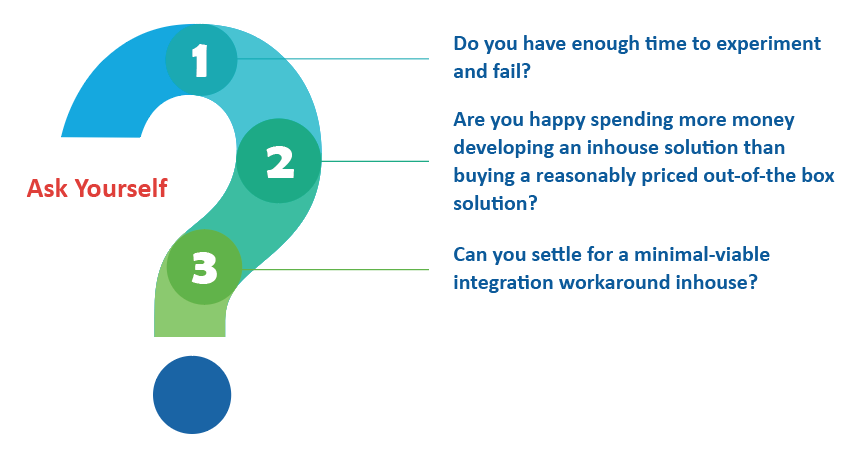
Building an inhouse integration solution takes a great deal of time. Therefore, if your need for an integration solution is urgent and time bound, building one from scratch may not be the best idea. Even if you put a lot of time and money into building the integration solution, until you are an expert in the domain with extensive experience, there is no guarantee that the solution you are making will be successful.
Though prima facie, the process of integrating two systems looks very easy by simply connecting the APIs of the source and target systems, the key question you should ask yourself is, ‘what kind of integration solution you need?’ If you just want your immediate integration needs to be addressed partially, you can go with the idea of building a minimal viable integration workaround in-house. However, if you are looking at integration as a strategy to simplify collaboration in your ecosystem, building a minimal viable integration workaround will not be enough.
3 – Technological competence to keep the solution up-to-date:
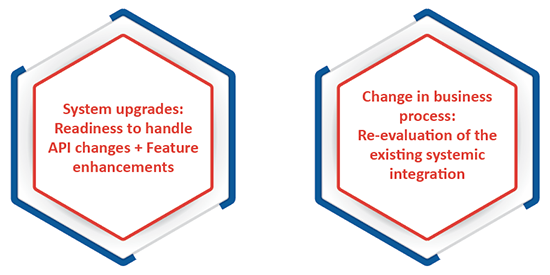
Unlike a decade back, software vendors, today, don’t follow bi-annual or annual cycles to release the upgraded versions of their software.
Upgradation can be as frequent as weekly or monthly. The react software. Therefore, before building an integration solution, you must ensure that your inhouse team is technically equipped, prepared, and available to make frequent changes to your inhouse integration solution. Advance planning not only makes it easier to adopt new features/releases but also significantly improve time to value.
4 – The impact of the investment on your core business:
Apart from niche skills and efforts required to design an integration solution, the collaboration between Integration Solution Vendors (ISVs) and software providers give the vendors an edge over inhouse integration solutions when it comes to testing pre-release copies or updates.
Therefore, if your core business is to create something else, it’s not worth investing time to develop an integration solution at the expense of your core business. It would instead be better for you to invest the time and money in enhancing your core business.
5 – Consider scalability in the long run:
Periodic changes in business processes, priorities, and models is common. These changes impact the way in which teams your organization and the corresponding systems interact.
In a situation like this, re-aligning the integration of all the systems and addition of new systems in the integration fold can become cumbersome. Most of Integration Solution Vendors (ISVs) are however ready to immediately accommodate such changes because they work with multiple software vendors and enterprises to deliver integration solutions for multiple systems & different kinds of business processes.
Is your inhouse integration solution equipped to manage?
Common issues with a minimal viable integration workaround
There are multiple such cases in which software providers whose core competence is something else came up with integration solutions, but with critical issues that can’t be ignored. The most common issues that these minimal viable integration workarounds have are as follows:
- Limited integration capability: More often than not, these integration solutions have limited capability when it comes to integrating different kinds of systems, entities, and servers. Absence of advance integration features such as workflow transition and mapping of different kinds fields creates multiple issues in the long run.
- Inconsistent synchronization: Inconsistent synchronization leads to data duplicity, data corruption, and conflicts in the source and target systems. In absence of a dedicated feature for detecting and manging conflicts and errors, it becomes cumbersome to go through multiple log files to detect and resolve the conflicts and errors. Issues like this don’t only affect the scope of scalability, they can also lead to significant monetary loss.
- Serious security loopholes: With no dedicated mechanism in place to guarantee data security and secure user access, critical data being synchronized through these integration solutions is often vulnerable to hacking and similar malpractices.
Conclusion
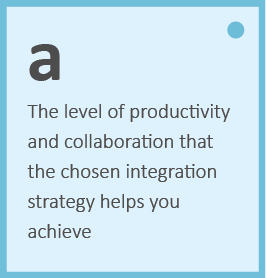
The two key aspects that you must consider while making the build versus buy choice is:
If building an integration solution unlocks a host of benefits, such as giving you a competitive advantage over your competitors and considerable monetary benefit without compromising on your requirements, then you can certainly consider an inhouse development plan. However, if you are planning to dabble into the integration solution space thinking it will be easier, economical, and quick to build an integration solution inhouse, you must reconsider your decision.