In today’s mission-driven landscape, speed and agility can’t come at the cost of traceability or compliance. Defense programs are navigating shifting priorities: compressed timelines, evolving mission profiles, and increasingly complex system-of-systems (SoS) architectures.
That’s why the U.S. Department of Defense has made MOSA (Modular Open Systems Approach) a foundational acquisition strategy for all major defense programs — mandated since 2019.
But meeting MOSA compliance isn’t just about modular hardware or open software. It’s about how those systems integrate to exchange, trace, and act on information—continuously and contextually—across the lifecycle. This is where open architecture principles and Model-Based Systems Engineering (MBSE) play a critical role.
At the center of this paradigm is the Digital Thread. And to operationalize it at scale, programs need more than integrations. They need federated interoperability—a core capability that OpsHub delivers.
MOSA in Context: The Shift from System-Centric to Mission-Centric Engineering
MOSA, as defined by the DoD, mandates open interfaces, modular components, and the ability to incrementally upgrade systems without vendor lock-in. Programs like JADC2, NGAD, and OUSD(R&E)’s Modular Open Systems Working Group are advancing this initiative with urgency.
For many defense contractors, the focus is now on MOSA implementation and compliance and how to translate the mandate into real program outcomes.
Key MOSA Goals:
But these goals demand a robust data infrastructure. Not just files or fields—but linked, contextual information flow across Model-Based Systems Engineering (MBSE), Product Lifecycle Management (PLM), Application Lifecycle Management (ALM), and Test domains.
The #1 Problem to Achieving MOSA: Toolchains Are Outdated and Fragmented.
Most defense contractors and suppliers agree in principle with the goals of MOSA. Modularity. Interoperability. Rapid innovation. It all sounds great — until you look under the hood of their current systems.
Here’s the reality: many of the tools used across the lifecycle — from requirements to design, simulation, verification, and sustainment — were never built to talk to each other. This creates fundamental system interoperability gaps and exposes major digital engineering shortfalls. Worse, they’re often legacy, siloed, and locked into proprietary formats.
We’ve seen:
- ALM tools that don’t sync with PLM systems operations?
- Simulation data trapped in proprietary software
- Manual data handoffs using spreadsheets and PDFs
- Audit trails lost in email threads
- Teams forced to “re-enter” the same data across multiple tools
This isn’t just inconvenient — it directly blocks MOSA. Because no matter how modular your components are, if your toolchain isn’t modular, you’re still stuck with brittle, high-maintenance workflows that can’t scale or evolve.
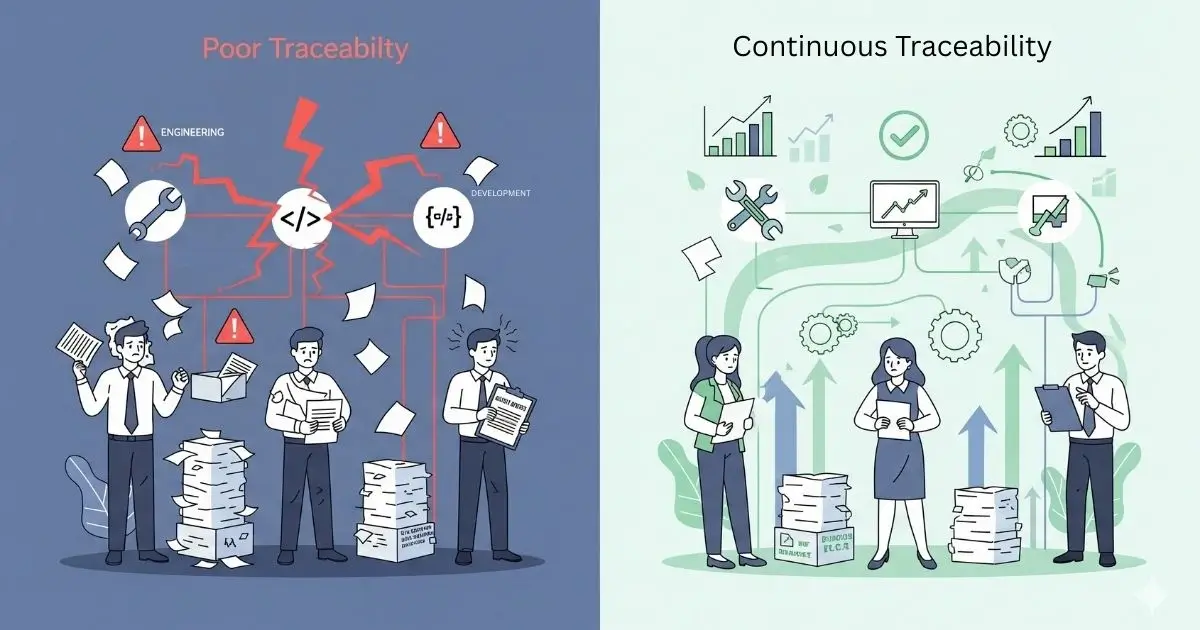
The End Result? Disconnected Engineering.
Defense leaders aren’t just managing technology to achieve MOSA – they’re managing outcomes under intense scrutiny, where mission assurance and program interoperability are on the line.
When your tools are siloed and your data isn’t traceable:
- Program reviews stall because traceability reports can’t be generated in time
- ATO approvals get delayed due to incomplete visibility into test and verification coverage
- System-of-systems coordination suffers—resulting in rework, integration failures, and misaligned deliveries
- Contract confidence drops as primes and subcontractors fail to demonstrate digital engineering maturity
- Audit exposure increases when compliance traceability can’t be proven on demand
These aren’t technical inconveniences. They’re mission threats—and they can cost your program millions in overruns, lost contracts, or failed milestones.
The Starting Point to Achieving MOSA: OpsHub, The Engine Behind a Federated Digital Thread
Engineering teams spend 30–40% of their time reconciling data across tools. With a federated thread, that becomes.
OpsHub Integration Manager (OIM) delivers a federated digital thread that spans 70+ engineering, ALM, and QA tools—without ripping and replacing what teams already use. Here’s how OpsHub perfectly aligns with MOSA’s five pillars: modularity, openness, interoperability, composability, and traceability.
OpsHub doesn’t centralize your systems. It federates them. Each tool continues to function as-is—preserving team autonomy—while OpsHub creates a seamless, traceable data flow behind the scenes. Engineers don’t need to switch tools or relearn workflows, they keep working in their native tool of choice.
- MOSA-aligned principle: Composable architecture without operational disruption.
Real-Time, Bidirectional Sync
OpsHub ensures always-on, bidirectional synchronization of artifacts, hierarchies, links, workflows, comments, attachments, and custom fields. Whether it’s a change in requirements, a test result, or a defect log—every update is instantly reflected across connected tools.
- MOSA-aligned principle: True interoperability, not brittle point-to-point scripts.
Modular and Standards-Driven Integration
OpsHub uses open APIs, supports REST and OSLC standards, and deploys flexibly—on-premises, in air-gapped environments, or in secure clouds. It connects legacy and next-gen systems with equal ease.
- MOSA-aligned principle: Open, modular systems that evolve without re-architecture
Traceability From Model to Mission
OpsHub provides end-to-end traceability across the lifecycle—from stakeholder needs and architecture models to software, verification, and deployment. It helps you comply with standards like MIL-STD-881, DO-178C, ISO 26262, and ARINC 429—without the typical manual pain.
- MOSA-aligned principle: Lifecycle traceability across system-of-systems.
Feeds Your Analytics and AI Stack
OpsHub can push clean, contextual data into your data lake or analytics layer—fueling AI, predictive QA, anomaly detection, and digital twin simulations. With full context preserved, you get more than dashboards—you get decisions.
- MOSA-aligned principle: Data-centricity and intelligence-ready architecture.
Non-Disruptive Tool Modernization: Evolving Without Stopping
When it comes to tool modernization under MOSA, many organizations face the challenge of shifting legacy systems while keeping operations intact. The risk? Major disruptions that stall projects and delay critical milestones.
With OpsHub Migration Manager (OMM), this isn’t an either-or situation. You don’t have to choose between keeping your systems in place and upgrading to a modern, modular infrastructure. OMM enables true non-disruptive modernization—empowering you to seamlessly integrate new platforms without ever taking your tools offline or forcing teams to adopt new workflows mid-project.
Impact: This approach allows your team to continue working in the familiar systems they rely on while gradually moving towards the more scalable, interoperable future that MOSA demands. No operational downtime, no productivity loss, and most importantly, no forced training sessions. Just a smooth, managed transition to the future of defense systems integration.
Paired with MBSE and open-architecture practices, OMM lets programs modernize toolchains while keeping the digital thread intact. You improve interoperability without downtime or forced rework.
In a nutshell:
Why OpsHub is Built for Defense-Grade Programs
Unlike traditional integration vendors, OpsHub is trusted by defense primes and national labs for one reason: we operate at the intersection of compliance, continuity, and mission assurance.
Unique Advantages:
- Zero plugin architecture: no performance impact, even in high-assurance networks
- Air-gapped support: sync behind firewalls, across classified enclaves
- Audit-ready traceability: MIL-STD-498, DO-178C, ISO 26262 alignment
- Migration-ready: federated sync + high-fidelity data migration supported
- Proven at scale: deployed in programs managing millions of artifacts across distributed projects
Real-World Insight: Traceability Breakdown Averted Before TRR
During a classified multi-platform ISR program led by a Tier 1 defense contractor, siloed MBSE and ALM systems posed a serious traceability gap. The team was using Cameo for system architecture and Jira for agile tasking—but there was no automated linkage between model elements and engineering work items. Verification artifacts in IBM ETM existed in a third silo.
As the program approached its Test Readiness Review (TRR), it became clear that validating test coverage against system requirements would take weeks of manual reconciliation—putting the review at risk and burning critical engineering hours.
By deploying OpsHub Integration Manager, the team:
- Automatically synced SysML blocks from Cameo with corresponding Jira epics and stories
- Established bidirectional traceability between requirements, work items, and test cases
- Enabled dynamic impact analysis on model changes during late-stage V&V
The result: full digital thread traceability restored ahead of TRR—without changing tools, disrupting teams, or compromising audit readiness.
Final Thoughts: MOSA is a Vision. OpsHub Makes it Real.
MOSA isn’t just a technical mandate—it’s a mindset shift. It calls for systems that are modular, traceable, composable, and responsive. But for MOSA to succeed, the digital thread must be more than a diagram—it must be alive, federated, and audit-ready.
OpsHub delivers the platform to make this real.
So if you’re asking:
- How do I make MBSE and PLM talk to DevOps and Test—without rework?
- How do I maintain compliance traceability across 8 tools and 10 teams?
- How do I modernize while still operating under today’s constraints?
You’re not alone. And you don’t need to start from scratch.
Your system-of-systems deserves better than spreadsheets and silos. Build a
digital thread that delivers continuity, compliance, and command-level insight. Let’s build your federated digital thread—secure, scalable, and on your terms.