Introduction
When the Aerospace and Defense Product Lifecycle Management (PLM) Action Group (AD PAG) met in March 2021 they had an imminent agenda. It was to study the use of the Digital Thread and create a road map for implementing it in the aerospace and defence sector (A&D).
The group’s members- Airbus, Boeing, Embraer, GE Aerospace, Gulfstream, Pratt & Whitney Canada (P&WC), Rolls-Royce, and SAFRAN- were keen to explore the myriad opportunities offered by the digital thread. This signalled the prominence this technology was poised to acquire in the complex A&D industry.
This article explores the crucial role the digital thread will play in revolutionising the aerospace and defence industry, and what other industry players can learn from it.
Trends Driving the Need for Digital Thread in the A&D Industry
The trend of digital transformation is touching manufacturing industries across various sectors. The A&D industry too is driven by the need to modernize its capabilities to meet the demands of the future.
Below are the major trends that are propelling this shift:
1. Fast Paced Innovation
Constant innovation is key for manufacturers to thrive amidst intense competition. The need to upgrade product performance and quality is pushing the barriers of creativity. The push towards military vehicle electrification, search for sustainable fuels, miniaturization in satellite technology, etc., are all creating the additional pressure of designing new products within shortened timelines. With products and processes becoming increasingly complex and sophisticated, the legacy systems that the A&D industry relied on are no longer able to keep up.
2. Dispersed Supply Chain
The extended global supply chain of the A&D sector relies on multiple players spread across the globe. Managing the widespread network of suppliers and sub-contractors in a volatile market is proving a challenge in today’s world. There is an urgent need to design a system that facilitates real-time updates and enhances traceability through the product life cycle.
3. Multidisciplinary Engineering
Modern A&D products are the culmination of expertise from diverse engineering disciplines like electrical, mechanical, software, etc. This translates to a need for seamless communication between the various teams working simultaneously on the same product. The isolated working environment of yesteryears only promotes information silos and is a major hindrance to achieving cross-team collaboration.
4. Sustainability & Circular Economies
Sustainability is no longer a buzzword but a mandate that enterprises must strive for. As the planet reels under pollution from emissions and product waste, there is immense pressure on polluting industries like A&D to make green choices. This enhances the need for tracing the origin of parts used in manufacturing to ensure they comply with green practices. The move towards circular economies implies a closed loop where the manufacturer is responsible for the product from procurement to recycling. This necessitates an integrated framework where the entire life cycle of the product can be charted.
5. Cyber Security
Data security is a rising concern in the information-sensitive A&D sector. With multiple internal and external stakeholders involved in the process, it becomes crucial to safeguard the data from cyber-attacks and data theft. There is an acute need for robust access controls, data encryption etc., to ensure data safety.
Where does the Digital Thread Come into Play?
With its innovative solutions, digital transformation can help overcome the current inadequacies plaguing the industry. The digital thread is an essential component of this change.
Here is how the A&D sector stands to benefit from it:
1. Collaborative Product Design & Engineering
Fast paced innovation requires quick and easy exchange of information between diverse departments. The Digital Thread makes this possible by providing a single source of up-to-date information accessible to all teams. It enables instant communication that fosters cross-team collaboration and reduces delays and errors.
When used in sync with the Digital Twin, the prototype design and testing process can be done in minimal time while maintaining the highest quality output. This method of virtual testing saves both time and resources that would be spent on physical product testing.
2. Streamlined Manufacturing
The legacy systems being used thus far in manufacturing lack interoperability. This causes barriers in the seamless flow of information from engineering designs to manufacturing. With the Digital Thread these silos are eliminated, and a fully integrated smart factory can be achieved. Such a framework is especially conducive to large-scale factory production lines found in A&D manufacturing. By feeding the data from digital thread to AI powered predictive tools, potential problems and opportunities can be identified at an early stage. These valuable insights can pave the way for unprecedented progress in increasing efficiency and effectiveness at each step of the manufacturing process.
3. Supply Chain Optimization
The A&D industry deals in heavy equipment which is constituted by multiple smaller components sourced from different vendors. This tangled global supply chain is a hindrance to speed and coordination. The digital thread simplifies this data architecture by offering real time supply chain visibility. Manufacturers can easily track components and parts to suppliers and streamline the assembly process. The ability to track components offered by the Digital Thread enhances collaboration with suppliers and aids in enforcing quality standards and compliance regulations.
4. Continuous Improvement
The digital thread monitors and stores information through the product lifecycle. This closed loop system is extremely beneficial for industries like A&D where continuous innovation is necessary. The product response from in-service aircrafts and defence systems is carried back to the design and engineering teams via the Digital Thread. This offers impetus for product improvement based on usage in the real-world, thus enhancing the customer experience and driving growth.
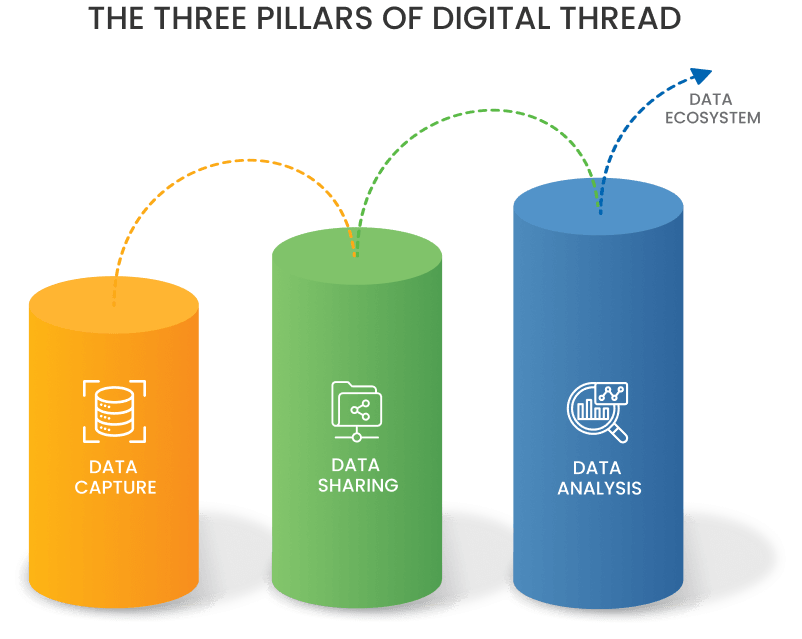
The Three Pillars Of Digital Thread – Capture, Share, Leverage Data
The primary purpose of digital thread is to create a data ecosystem that allows seamless integration and data accessibility across teams and stakeholders.
To achieve this task, it relies on three foundational components:
Data Capture which involves capturing data at all touchpoints of the product’s lifecycle. The availability of this data drives the digital thread by consolidating a repository of real-time information that is traceable and documented. Precision in data collection is non-negotiable, as incomplete or inaccurate data compromises the integrity of the entire thread
Data Sharing emphasizes the unobstructed sharing of data across teams and departments. Without this ability the captured data is just siloed information that does not promote transparency and collaboration. Therefore, to optimize the effectiveness of digital thread a robust data sharing framework that facilitates the exchange of information is crucial.
Data Analysis is the enabler of acquiring actionable insights from the captured and shared data. For an enterprise, this capability to turn raw data into intelligence is what adds value to the digital thread infrastructure. This information can be used to guide decision making, identify potential problems to run predictive maintenance, and highlight any inefficiencies impeding smooth operations.
Conclusion
As enterprises in the A&D sector realize the benefits accrued by the Digital Thread, it will soon become necessity rather than choice. Its ability to foster innovation, accelerate development, and enhance collaboration to bring about a true digital transformation is easily recognizable. If you are aiming to build a digital foundation to scale to a modern enterprise then consider partnering with a Digital Thread solutions provider to accelerate the journey.