In a world where every business is a software business, it is important to innovate at the pace of change to survive the competition and future-proof your business. Innovative ideas and business models are fast replacing traditional models as innovation trumps incremental efficiency. But how do organizations accelerate the delivery of high-quality products and services, in shorter release cycles, faster than their peers to get the early movers advantage?
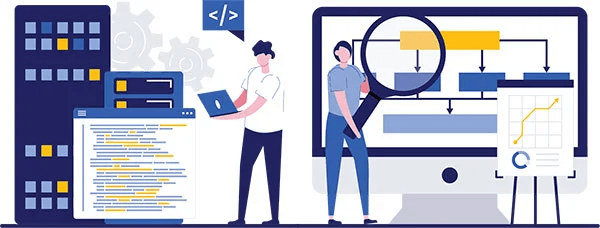
Software innovation teams that manage builds, develop, test, deploy and deliver use specialized best-of-breed tools that are fit for purpose. While this offers team members the benefits of modern, agile tools, it often leads to data integration and process automation challenges across the toolchain.
To make informed choices, each member of a software development team, be it a product manager, a developer or a tester needs complete information and rich visibility into their preferred tool.This brings us to the most important question: how do we unify all our applications under one ecosystem? And what’s the best approach for integrating applications?
The problems, as well as the solutions to them can be categorized in two ways: Data orchestration, or data federation challenges. To understand how the two approaches to application integration – data orchestration and federation work, and how they differ from each other, read on.
What is application integration?
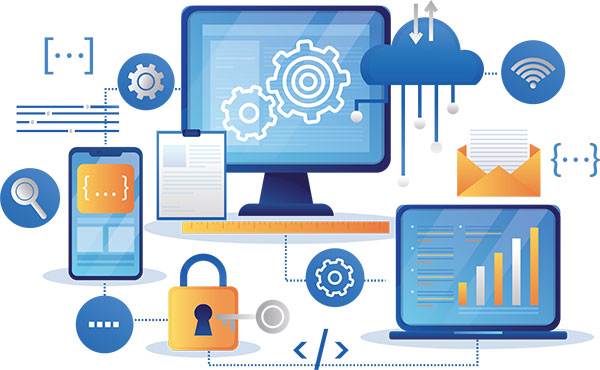
Application integration is the process that enables individual applications that were built separately, to work together. This unification ultimately results in enhanced capabilities, faster innovation, and better insights to deal with business challenges. By merging data between multiple software applications, enterprises equip themselves with a modernized infrastructure – that supports agile workflows.
Orchestration: The challenge and the solution
In its essence, data orchestration is the undoing of data silos and fragmentation, to make your data more accessible for teams and be put to better use for crucial business operations. The process of data orchestration can be defined as collecting siloed data from different locations, organizing it, and making it available for multiple business purposes like – analysis, product development, delivery, etc.
Orchestration solutions solve the problem of needing to get data from multiple sources and then acting on that data in a local transactional way. They provide a programmed workflow that automates repetitive, time-consuming processes. These orchestration solutions are often complex and require extensive development efforts to deal with multi-step processes.
But for all their complexity, these tools do not guarantee reliability or integrity of replicated data across multiple systems, because that is not the problem they were designed to solve.
Federation: What makes it a challenge and a sought-after enterprise solution?
Put simply, data federation is the software process that enables multiple databases to function as one. Enterprises need a federation-based approach most when there are multiple replicas of data, each residing in a different system of record, which needs to be kept consistent across all systems – even as they are being worked on and possibly updated in one or more systems.
Data federation solves one of the most crucial business problems – effectively managing data. And it does this by integrating multiple databases in one single format, saving the time and money that would be for building and managing another storage system.
The promise of Eventual Consistency
While at any given point in time, two systems might not be 100% consistent (given the nature of independent systems working in parallel), it is crucial that the underlying federation system is able to guarantee eventual consistency – that after a period of time, all the data will be updated, in all systems, in a logically consistent manner.
In order to guarantee such eventual consistency, the system must support bidirectional synchronization and have a mechanism for monitoring the changes to the data set that doesn’t require a full scan – so that only differences need to be updated. Moreover, it should have a defined method to detect out-of-sync entities and consistent rules to be applied to such entities.
How OpsHub’s federation solution solves the biggest application integration challenges
For federation-based integration, OpsHub is the only solution.
OpsHub Integration Manager (OIM) creates an enterprise federation fabric and ensures the availability of complete, rich interconnected information in each person’s tool of choice. OpsHub’s unique bidirectional sync mechanism was designed to solve the federation problem and is the only tool ensuring data consistency across disparate systems.
By breaking down information silos, OpsHub empowers innovation teams to make data-driven, well-informed decisions, and to deliver higher quality products for fast-paced, ever evolving markets.
Download the PDF to read the complete version of this blog post.