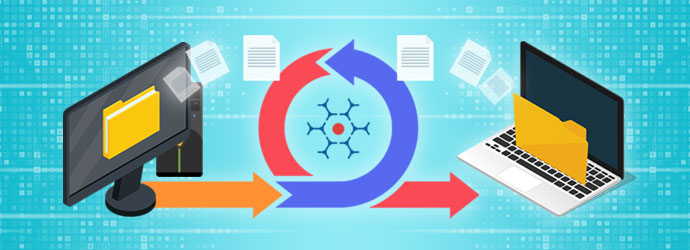
With new innovative tools being released in the marketplace which can significantly improve productivity and/or help create differentiated products and services, there is a need for users to migrate from one tool to another. Other business reasons that necessitate the need for data migration are:
- Mergers and Acquisitions,
- Regulatory and Compliance adherence,
- Tools consolidation within the organization, or
- Reorganization within a large enterprise
Enterprises spend millions of dollars to migrate data and despite this investment, migration exercise is rarely successful. Poor migration will lead to loss in productivity and sub-optimal decisions in future due to loss in data fidelity. It also leads to:
- Significant system downtime leading to idle expensive resources
- Increased time to value
- Cost and time overruns in the project
In this blog, we will discuss the key criteria for enterprises to choose the right kind of migration solution and help come up with the right strategy.
Planning is the key
The planning for data migration is never easy and cost is always a big concern. However, the hidden cost of not completing the migration on time is significant. The cost calculation in case of migration project not completing on time should take into account the following factors:
- Delayed revenue generation
- Delayed product introduction
- Customer dissatisfaction/attrition
- Cost of unproductive resources and unexpected downtime
However, with a sound strategy that is tied to the larger business objective, the choice of right migration solution, and enforcement of the best practices for migration – it is possible to execute a successful migration project on time, without any loss or distortion. Factors such as data security, data fidelity, time required in migration, compatibility between source and target systems, system downtime involved, and resources allocated for the migration must be considered before the migration solution is chosen.
A successful data migration means transfer of quality data in time
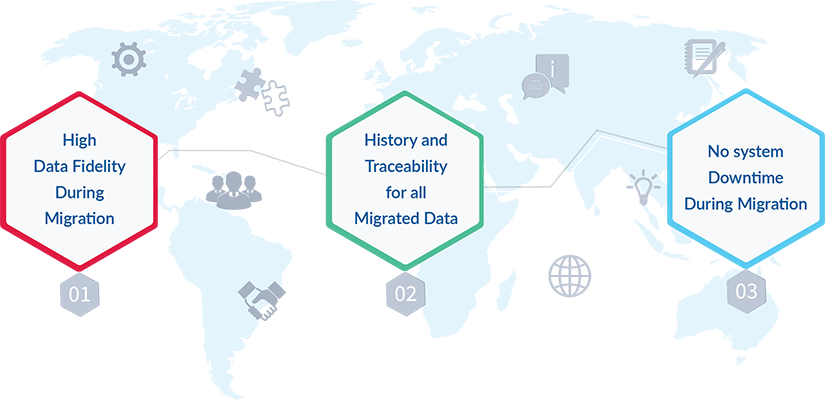
Data migration is always tied to a larger business goal and a quicker and successful completion of data migration obviously assists faster accomplishment of the goal. With the right planning and right solution, data migration can be a hassle-free process and provide long-term business benefits. A successful data migration solution must ensure:
High data fidelity during migration: Data quality is one critical parameter on which the success of a data migration solution must be evaluated. In a migration project in which the source and target systems are disparate, not designed to interact, and share no common structure – maintaining high fidelity becomes very difficult. The problem becomes even bigger if the source system is a legacy system with outdated formats. However, a good migration solution would take care of the disparities between the systems and ensure that the data is transferred in the right format without any errors. In the long run, this ensures that no incorrect business decisions are taken due to imperfect, erroneous, or missing information in the target system.
History and traceability for all migrated data: From a compliance point of view, it is extremely critical to have all transaction records of all data present in the system currently in use. For example, in case of migrating a development tool, it is important to migrate the full-context around the user story lifecycle and traceability to its parent artifacts. Migrating history and traceability of data is critical in general but more so in a migration project involving mergers and acquisitions. Successful transfer of complete, contextual information (which also includes all the comments and attachments) also ensures that stakeholders don’t have to keep going back to the older system for reference. It also takes away the direct and indirect cost as well as the hassle of keeping the old system running even after migration.
No system downtime during migration: With the high volume of data that any organization processes these days, it shouldn’t be astonishing if the time estimated for migration runs into a few weeks or even months. Locking users out of the system while migration process takes place, therefore, becomes an expensive proposition for any business. However, a good migration solution would allow users to use the system while the migration is in process. While the migration is in process, a good migration solution will allow use of both the systems simultaneously and train the people in batches to use the new system. This would ensure that data migration is cost-effective, and non-disruptive for the business.
Failure is not a problem, not having a right recovery mechanism is a problem
Any data migration process, however carefully planned and executed, may run into failures due to complexity of the processes, data inconsistencies and the heterogeneity of the systems involved. However, if the migration solution offers a sound recovery and reconciliation mechanism, it will prevent from data loss as well as lost time if the migration can be restarted from the failed point. For example, if a migration is estimated to be completed in 20-hours fails in the 12th hour for some reason, with a good migration solution, it can be recovered and restarted from where it was left off. This is also one key aspect to look for while choosing a migration solution. It is especially important for large complex migrations where failures could lead to significant delays. In some cases, enterprises may have to choose between not migrating the data and migrating data with errors.
Conclusion
Data migration is the first step towards a larger goal – leveraging a new tool in the ecosystem. However, unfortunately, enterprises tend to follow an oversimplified, and sometimes, unplanned or under-planned approach towards data migration. Thorough planning in choosing the right migration solution beforehand helps in understanding the hidden challenges in the process and helps in validating the quality of the chosen migration solution. It is also important to understand that data migration is not simply about achieving one business goal, it has a larger impact on the overall health of the ecosystem. Successful data migration ensures that organizations always work with accurate data that supports the needs of the business, mitigates the risk of delays, bad quality products, and budget overruns.