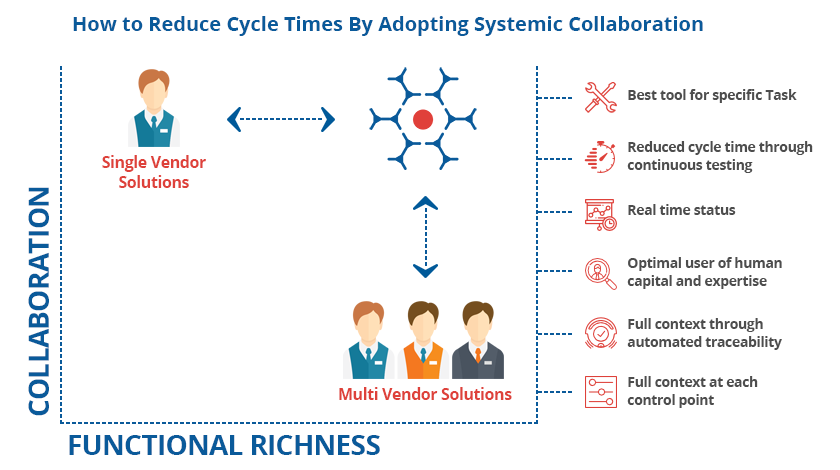
The technology landscape, today, is evolving to accommodate the changing demands of the customers, who want the best quality solutions in the shortest possible time at a lower cost. But is it feasible to shrink the cycle time further without compromising on the quality while reducing cost? While it may seem impossible to achieve all three objectives together, by introducing systemic collaboration across the IT organization’s ecosystem, it is possible to deliver excellence on all three dimensions.
Often different tools (portfolio, ALM, QA ) are siloed and don’t talk to each other. That results in manual time consuming process for information sharing and collaboration, resulting in higher cost and longer cycle times. And, even quality may be compromised sometimes to meet time-to-market objectives.
It all boils down to the need for rich, in-context collaboration that can only happen if the underlying IT ecosystem is integrated. In an integrated ecosystem, a product owner using a specialized agile management tool, such as Rally, Digital.ai Agility, etc. has full visibility into the real-time status of all the user stories as well as feedback from QA teams, even though those teams are using their own specialized tools, such as TFS, Jira, Micro Focus ALM, etc. – all of this in his/her own tool. This enables them to have full context and continue to collaborate effectively, in real-time, even though they are using different tools. As a result, the teams are able to deliver quality solutions faster, at a lower cost.
In this blog, we will discuss how organizations can create seamlessly integrated ecosystems, to bring down their cycle times and costs without compromising on quality.
Making multiple, disparate systems talk
By making the multiple, disparate, cross-functional systems talk, organizations can enable all teams to have full context of all relevant information, in real time. This not only enhances the collaboration between the teams, but also help these teams take better decisions collaboratively without abandoning the best tool for their roles.
Due to the inherent transparency and collaboration in this setup: - The exchange of customer data happens in real time, with complete context, and without any manually-induced errors and delays.
- All teams have holistic view of customer information and all of them work with unified set of facts and enabling them to make the right choices independently.
- Teams are no longer spending time to sync-up information, prioritizing tasks, and struggling to define agreeable timelines, thereby focusing more on building great solutions and experiences.
Below is an example of how systemic collaboration can bring synergy within an ecosystem and help increase the efficiency of an organization:
Problem: A big student information systems company, one of our customers, was trying to bring down the time taken in resolving customer tickets. Their support team was using Zendesk and development team was using Rally, which were tools best suited for their roles. Since the systems were not integrated with each other the data won’t, automatically, flow from one system to another. The teams had to manually update their systems for every interations on each ticket, which led to delay and errors.
Solution: By integrating their support and development systems, using OpsHub, the customer significantly brought down the resolution time for their customer tickets. The integration also led to seamless exchange of information between both the teams – which increased cross-team collaboration and reduced the instances of manually-induced errors and delays.
Long term impact of systemic collaboration
Systematic collaboration doesn’t only accelarate quality delivery, it also impacts the business strategies and customer relationships in the long run.
Seamless systemic collaboration leads to complete and effective communication between the teams. When same level of information is accessible to everyone, there are lesser chances of blind spots in the processes.
Evaluating the systems in an age of systemic collaboration can be challenging: not all best-of-breed systems are collaborative, not all collaborative tools are functionally rich. To bring the best-of-breed, heterogeneous tools together and make them work effectively, a seamless integration platform that can connect these systems is ineludible.
Last but not the least, with systemic collaboration, it is possible to tighten Service Level Agreements and prioritize critical issues immediately.
Reach out to us for a free consultation on tool selection including in-depth analysis of tools under consideration. You can drop your comments on the blog below, and we will respond to you as soon as possible. OpsHub Integration Manager (OIM) is a preferred integration solution that comes along with many popular ALM, DevOps, IT Service Management (ITSM), and Customer Relationship Management (CRM) tools. OIM supports integration for 60+ ALM, CRM, ITSM, and DevOps tools. To see the list of tools OIM supports for integration, click here.
Find out more about OpsHub partner program.