The defense industry is entering a pivotal phase of transformation. With the release of DoDI 5000.97, the U.S. Department of Defense (DoD) has made its position clear: the future of acquisition is digital, model-centric, and connected across the entire lifecycle.
This directive marks a turning point for the Defense Industrial Base (DIB). Organizations that modernize their engineering environments will be positioned to lead next-generation programs. Those that fail to adapt risk falling behind in an increasingly digital ecosystem.
DoDI 5000.97: A New Era for Defense Engineering
Released in December 2023, DoDI 5000.97 formally establishes the framework for Digital Engineering (DE). The directive introduces mandatory requirements for new programs, while existing programs are encouraged to adopt DE practices wherever possible.
The goal is to move away from fragmented documentation toward integrated digital models. By shifting to these models, organizations can:
- Collaborate across disciplines in real time.
- Simulate performance earlier in development.
- Maintain traceability from requirements to testing.
- Accelerate the delivery of operational capabilities.
From Documents to Models
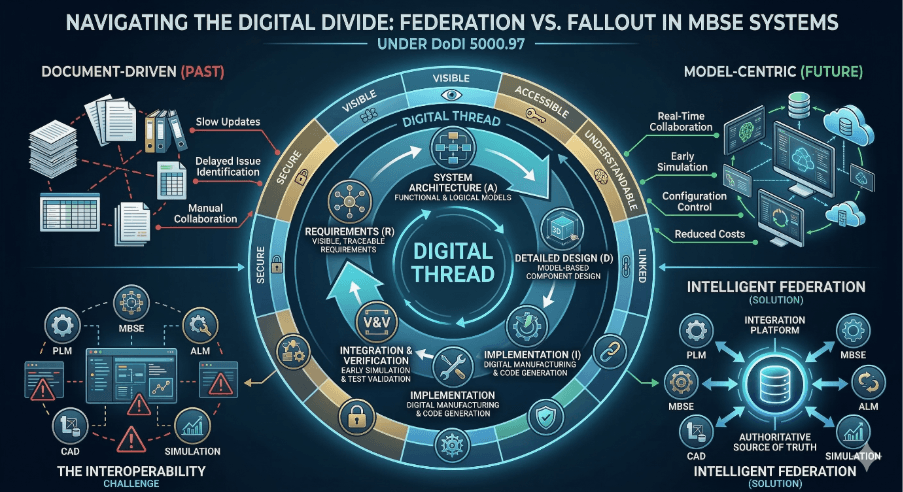
For decades, engineering has relied on static documents—specifications, spreadsheets, and test plans. These workflows are slow, manual, and often lead to costly late-stage design changes.
Digital Engineering replaces these artifacts with Model-Based Systems Engineering (MBSE). Instead of exchanging PDFs, teams collaborate through live models representing system behavior and architecture. This shift allows for the early detection of design issues, but it significantly increases the need for tool interoperability.
The Interoperability Challenge and the Digital Thread
One of the biggest obstacles is the complex tool ecosystem used across the DIB. Suppliers use specialized systems for PLM, MBSE, ALM, and simulation. Integrating these into a cohesive environment is difficult, especially when collaborating across different organizations.
At the center of this transformation is the Digital Thread – a continuous flow of information connecting every stage of development, from initial requirements to long-term sustainment. This connectivity ensures that decisions remain visible and traceable. However, achieving this requires consistent data exchange across diverse platforms.
Data Governance: The VALTIS Framework
DoDI 5000.97 aligns with the DoD data strategy, defining seven key attributes for defense data, often referred to as VALTIS:
- Visible, Accessible, Linked, Trustworthy, Interoperable, and Secure.
A critical requirement is the creation of an Authoritative Source of Truth (ASoT). An ASoT ensures all stakeholders rely on the same validated information, providing the configuration management and auditability necessary for complex defense systems.
Why Monolithic Platforms Fail
Some organizations attempt to solve these challenges by replacing all existing tools with a single, monolithic platform. In practice, this rarely succeeds. Suppliers have decades of investment in specialized systems, and large-scale migrations introduce significant operational risk. Furthermore, the DoD does not require identical tools it requires interoperability.
Intelligent Federation: A Practical Path Forward
A more effective strategy is Intelligent Federation. Federated architectures connect existing systems into a unified ecosystem while allowing each tool to perform its specialized function. This allows suppliers to:
- Synchronize data across multiple systems.
- Maintain end-to-end traceability.
- Preserve existing workflows and investments.
Enabling Digital Engineering with OpsHub
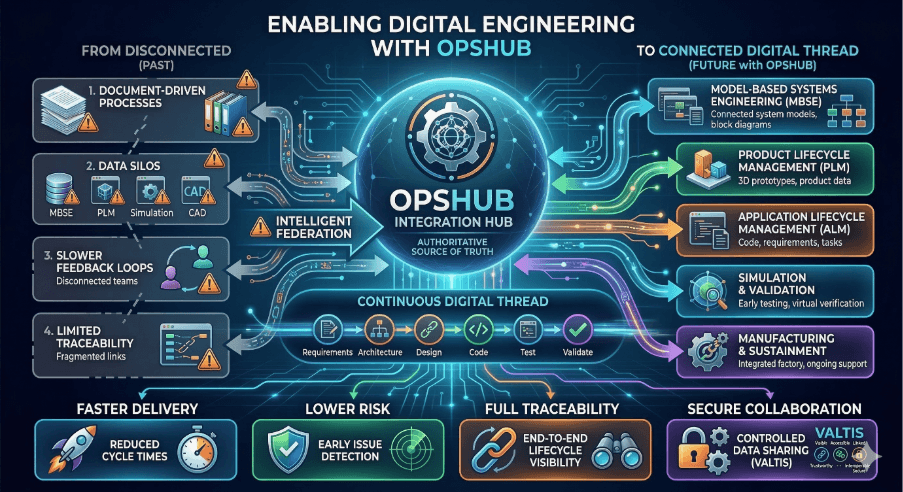
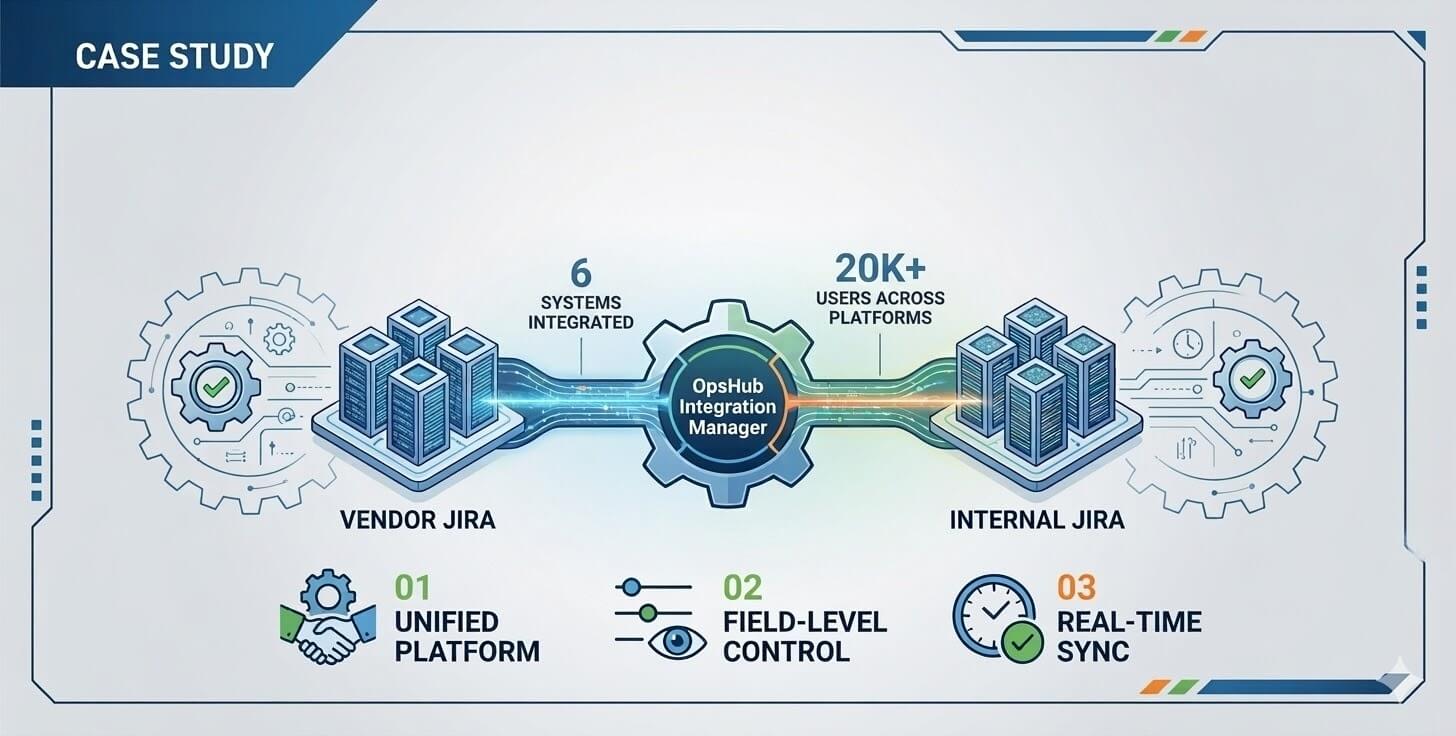
OpsHub provides an integration platform specifically designed for these complex ecosystems. By enabling bi-directional synchronization between PLM, ALM, MBSE, and DevOps tools, OpsHub helps organizations establish the interoperability required by DoDI 5000.97.
Through role-based access and controlled data exchange, OpsHub allows suppliers to participate in the Digital Thread without abandoning their proven tools. This ensures that engineering data flows seamlessly, supporting lifecycle traceability and secure collaboration across organizational boundaries.
The Future is Integrated
The message from the DoD is unmistakable: Digital Engineering is no longer optional. Success now depends on the ability to build connected engineering ecosystems. Suppliers that embrace interoperability and federation will deliver systems faster and reduce development risk, becoming essential partners in the next generation of defense innovation.