Quality product, short release cycle, and superior customer experience are the three primary expectations of a customer today. To meet these requirements, organizations have been rapidly adopting agile methodology. However, one of the main challenges organizations face on their agile journey is selection of tools that would complement and not hinder their new processes.
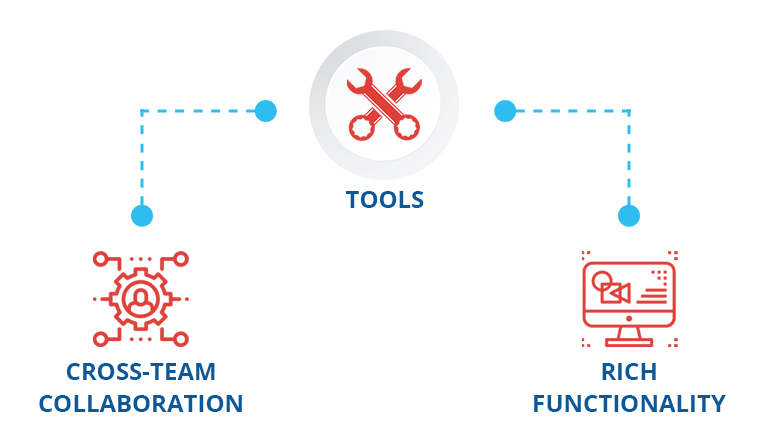
The functionality versus collaboration debate
To optimize their effectiveness, different teams within an organization want to use tools that are best suited for their tasks. This often leads to a conglomeration of multiple, disparate tools in the ecosystem and impacts collaboration. Organizations sometimes force all the teams to use the same tool to ensure rich collaboration and that compromises productivity and effectiveness.
For example, many organizations, while selecting a tool, prefer a collaborative Application Lifecycle Management (ALM) tool with multiple features over a best-of-breed tool dedicated to a function. Often, the dev team, because of their size, drive the choice of the tool. The product team, quality team and business analysts are forced to use tools which lack critical features for their specific tasks impacting their productivity.
Organizations choosing functionality over collaboration go with siloed best-of-breed tools making all the teams like development, quality, product and business analysts highly productive. However, they are forced to rely on manual time consuming process for information sharing and collaboration. This leads to increased cycle times and sub-optimal decisions.
A new way forward
Integration platforms, like OpsHub, which provide rich integration between best-of-breed tools, provide another option – each team can use tool of its choice without compromising on cross-team collaboration.
The integration enables a unified Agile ecosystem which reduces cycle time and democratizes decision making. However, this requires additional considerations when selecting best-of-breed tools – ability to interface with integration platforms like OpsHub.
With OpsHub, you don’t need to compromise between functionality and collaboration.
Additional criteria for best-of-breed tool selection
Standard Web Services based API: Ability to programmatically manipulate all aspects of information stored in the tool is key to integration. Hence the tool must have APIs which allows an integration platform to read and manipulate content in the tool. At the same time, the access to API should be controlled and only provided to API calls with valid, authenticated logins. It is important to check whether the API can integrate with leading identity and access management vendors or supports open standards for identification and authentication.
Access to Metadata: The API provided by the tool should support ability to access all aspects of metadata like projects, artifact types, fields, and relationships. It should be feasible to dynamically discover user customizations and configurations.
Change tracking capabilities: Often it is important to have full history of an artifacts journey through its lifecycle be visible in all the tools. For example, for a defect synced across multiple tools, it may be critical to have visibility into transition activities, instead of just the current state, in every tool. For this reason, the tool should have strong change tracking feature. It should provide mechanisms for people to query full history of any artifact changes. It should provide APIs to the history logs, so that integration platform can easily detect and propagate changes across various best-of-breed tools in the ecosystem while maintaining history. This helps in ensuring all the activity information is properly synced to connected systems.
Conclusion
A unified Agile ecosystem consisting of best-of-breed tools integrated with an efficient integration solution will facilitate the creation of a highly productive and customer-centric organization, which in today’s digital world is key to customer retention.
In the new world, siloed tools will need to be replaced because they are a hindrance to productivity and providing good customer experience. That will lead to additional migration costs and exposure to risks such as data loss in the long run. Hence selecting a best-of-breed tool, factoring in the ability to interface with integration tools is extremely important. Having the right tool fully integrated ecosystem makes the organization more productive and deliver phenomenal customer experience.
To find out how OpsHub Integration tool facilitates rich integration among best -of-breed tools, connect for a complimentary consultation session with our integration expert.
Find out more about Migration Challenges here.