The Coming Divide in Defense: Federation or Fallout Under DoDI 5000.97
Share: The defense industry is entering a pivotal phase of transformation. With the release of DoDI 5000.97, the U.S. Department of Defense (DoD) has made


No-code integration platform for rich bi-directional sync

Zero downtime migration to tool of your choice

Keep Historical Data, Without Slowing Down Your Tools

Migrate or restructure Azure DevOps

Real-time, context-rich data lake for AI or analytics
By Role
Accelerate delivery with clear insights

Accelerate delivery with clear insights

Transform smarter with a connected digital thread

Confident transitions for every enterprise change
By Initiative

Operational readiness through connected engineering

Modernize and move to cloud without disruption

Build a compliant digital thread for complex environments

Build the foundation for smarter AI
By Domain

No-code integration across teams and systems

Enable collaboration between IT, support, and business teams

Connect PLM & engineering teams for smarter products

Ensure regulatory compliance from start to release

Explore the latest in technology best practices

Success stories from the field
Actionable insights for your business challenges.

See solutions in action

Learn, plan, and execute with confidence

Official announcements and updates

Join discussions that drive results

Stay ahead with curated insights

Share: The defense industry is entering a pivotal phase of transformation. With the release of DoDI 5000.97, the U.S. Department of Defense (DoD) has made
According to McKinsey, the adoption of cloud migration could generate $3 trillion in global value by 2030. The statistics are proof of the potential of data cloud migration to revolutionize business performance and drive cost efficiency. Let’s learn more about cloud data migration and its benefits for enterprises.
Cloud data migration can have a transformative effect by streamlining business processes boosting performance. The benefits include:
Cloud data migration can have a transformative effect by streamlining processes business processes boosting performance. The benefits include:
Migrating data to the Cloud comes with a set of challenges that must be addressed for a successful, non-disruptive transition.
The most pressing challenge for enterprises is the downtime for transferring data which can lead to business disruption and affect productivity.
Security of the data in transit is another concern. Data breaches or unauthorized access can be avoided by choosing a reliable partner who fulfils the security and regulatory compliance standards for cloud migration.
The issue of compatibility may also arise during or after cloud migration. It is therefore imperative to ensure that data and application dependencies align with the cloud infrastructure.
Unlike most tools, OpsHub Migration Manager has the ability to transform data – align mismatched project structures, eliminate duplicates or redundant data to ensure you only take accurate, structured data to the cloud. The platform also allows for easy reconciliation and reverse sync of data in case of any errors or request changes. This can be extremely helpful in minimizing setbacks, and ensuring continuous access of data.
Finally, transferring large volumes of data requires expertise to ensure data integrity and address any scaling needs. A thorough understanding of the enterprise’s data architecture and dependencies is crucial to designing a sound migration strategy. Therefore, choosing a cloud solutions partner with the domain expertise in handling high-stakes data migration projects is critical to the success of cloud migration initiatives.
Based on the category of data moved, cloud migration can be of four types:
Storage Migration: The transfer of legacy storage to cloud-based storage solutions to enhance accessibility and reduce maintenance costs.
Application Migration: Shifting applications, workloads, and processes to a cloud environment for performance optimization and enhanced security.
Database Migration: A database migration involves shifting data to a cloud while transforming and restructuring it to align with the new environment.
Business Process Migration: This is an enterprise-wide activity involving the moving of databases, systems, and applications to a cloud-based system. Benefits entail agility, faster innovation, and improved efficiency.
Depending on the migration technique, there are two approaches to cloud data migration:
Cold data migration, or traditional data migration is an approach which involves the transfer of data from one application to another in a time-inducive manner. Here the operations of the enterprise stop while the migration takes place. No changes can be made to the source data till the migration process is complete. Users only regain access only after validation and sign-off, when they have finally transitioned to the new system.
This strategy is fruitful only for infrequently accessed data that can be turned off with minimal impact to the business. While it can be a cost-efficient practice, the delays incurred make it counter-productive for active data and processes.
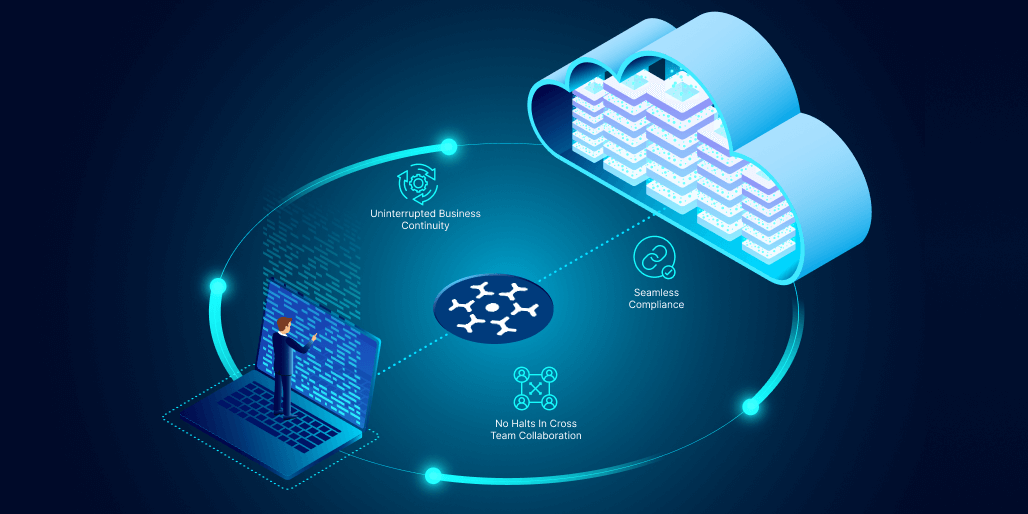
Live data migration involves the transfer of data without the need to shutdown systems or endure downtime. Teams can continue working as the data transfer takes place in the background. Unlike cold migration, there is no downtime as the systems are live and all data is accessible.
OpsHub’s live++ data migration approach takes it a step further by providing full continuity throughout the migration process. Besides ongoing access, data can be synced bi-directionally ensuring that the source and target systems remain aligned. This ensures not only elimination of downtime but also ensures zero business disruption for the teams involved in the migration.
Since the data is available in both new and old systems at the same time teams can collaborate effectively across different phases of migration and run comprehensive, aggregate reports across all waves of the migration.
This makes OpsHub’s Live++ Data Migration an ideal solution for enterprises seeking the advantages of cloud migration without enduring any system downtime or business disruption. It allows for modernization of business processes without disrupting continuity or affecting ongoing operations.
What makes OMM the trusted choice for smooth, non-disruptive cloud migrations.
Cloud data migration can be a complex and expensive process if not executed correctly. OpsHub Migration manager is a powerful tool that allows enterprises to migrate their mission-critical data to the cloud without any business disruptions and zero downtime. It also allows limitless scalability to cater to evolving business needs.
Here’s what sets OMM apart:
A well-defined data migration strategy coupled with an experienced solution provider is the core requirement for any cloud data migration. As databases continue to grow exponentially, cloud data migration is a mandate rather than an option to equip businesses with the agility they need to thrive with change and market disruption. With the right tools and expertise, enterprises can navigate through the complex nature of migration to enjoy the accelerated benefits it offers.
Experience the Power of Non-Disruptive Data Migration with OMM
Aparna Garg is the Director of Products & Marketing at OpsHub. She has been intimately involved in the development of OpsHub Integration Manager and aligning it with customer needs. Her in-depth understanding of shifting market trends and zeal to deliver nothing but the best to the customers has been phenomenal in driving OpsHub Integration Manager’s journey towards becoming the one-stop solution for all kinds of enterprise-level integrations.
Muskaan works as an Associate Manager, Marketing at OpsHub. Her interests include devising content marketing strategies for SaaS enterprises, brand strategy and the convergence of product-first thinking with emerging tech and communication.