The Coming Divide in Defense: Federation or Fallout Under DoDI 5000.97
Share: The defense industry is entering a pivotal phase of transformation. With the release of DoDI 5000.97, the U.S. Department of Defense (DoD) has made


No-code integration platform for rich bi-directional sync

Zero downtime migration to tool of your choice
Keep Historical Data, Without Slowing Down Your Tools

Migrate or restructure Azure DevOps

Real-time, context-rich data lake for AI or analytics
By Role
Accelerate delivery with clear insights

Accelerate delivery with clear insights

Transform smarter with a connected digital thread

Confident transitions for every enterprise change
By Initiative

Operational readiness through connected engineering

Modernize and move to cloud without disruption

Build a compliant digital thread for complex environments

Build the foundation for smarter AI
By Domain

No-code integration across teams and systems

Enable collaboration between IT, support, and business teams

Connect PLM & engineering teams for smarter products

Ensure regulatory compliance from start to release

Explore the latest in technology best practices

Success stories from the field

Actionable insights for your business challenges.

See solutions in action

Learn, plan, and execute with confidence

Official announcements and updates

Join discussions that drive results

Stay ahead with curated insights

Share: The defense industry is entering a pivotal phase of transformation. With the release of DoDI 5000.97, the U.S. Department of Defense (DoD) has made
OpsHub Integration Manager
Connect IT service management and engineering teams with two-way sync between BMC Helix ITSM (also known as BMC Remedy) and Azure DevOps. Eliminate manual escalations, preserve service context, and resolve requests faster.
Request a demo
Service requests logged in BMC Helix (formerly named as BMC remedy) often need engineering work in Azure DevOps. The handoff is where things break. Details get lost, attachments don’t transfer, and teams chase status updates manually. IT Service teams can’t see what’s happening; engineers lack context, and resolution drags.
OpsHub Integration Manager connects both systems with near real-time, two-way sync. Service requests move into Azure DevOps with complete information. Engineering updates flow back automatically. Both teams work in their native tools while staying aligned, no manual handoffs, no information gaps.
Trusted by the world’s leading enterprises


Integration that adapts to how you work
OpsHub fits into existing processes without forcing change. It supports multiple Azure DevOps and Remedy instances integration, and high data volume so teams can scale without rework.
Secure, scalable setup without plugins
Configure and manage integrations through a simple UI or APIs, no coding, no plugins, no risky installs inside your tools. Recovery is automatic if systems go offline.
Complete, context-rich synchronization
OpsHub goes beyond basic fields. Comments, attachments, formatting, relationships, and rank stay intact across systems, with flexible mappings to match real business needs.
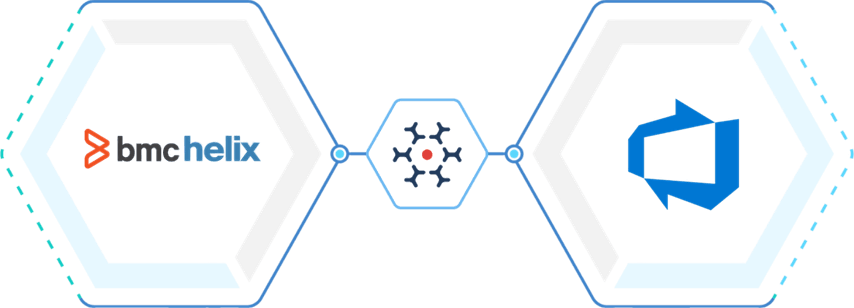
OpsHub Integration Manager connects BMC Helix (formerly named as BMC remedy) and Azure DevOps in near real-time, preserving complete service and engineering information across both platforms.
BMC Helix to Azure DevOps:
Service requests with priority, impact assessment, request history, diagnostics, attachments, and related ticket links.
Azure DevOps to BMC Remedy:
Work status, developer notes, sprint assignments, blockers, and resolution details.
Updates flow continuously in both directions. Service requests and engineering work stay connected, so teams always see status.
OpsHub operates externally via secure APIs, no plugins, no performance impact, no upgrade failures. Handles custom fields and multiple projects without workflow changes.
Result: Engineering receives full-service context. Service teams get automatic updates. Both sides move faster with complete information.
Steps to integrate GitHub and Azure DevOps
Step
Configure BMC Helix and Azure DevOps connections
Step
Select projects and entities to be synchronized.
Step
Define sync direction and filters
Step
Map fields and activate synchronization
Problem Statement
Service requests exist in BMC Remedy. Engineering execution happens in Azure DevOps. Without integration, escalations are manual, context gets simplified, and status doesn’t sync back. Service teams lose visibility; engineers lack details, and the resolution slows.
Goal
Align service and engineering teams through automated information exchange between BMC Helix (formerly named BMC remedy) and Azure DevOps.
Business value offered numbers
Better Resource
Utilization
Increase in Customer Satisfaction
0%Growth in SLA Turnaround Time
0%