The Coming Divide in Defense: Federation or Fallout Under DoDI 5000.97
Share: The defense industry is entering a pivotal phase of transformation. With the release of DoDI 5000.97, the U.S. Department of Defense (DoD) has made


No-code integration platform for rich bi-directional sync
Zero downtime migration to tool of your choice
Keep Historical Data, Without Slowing Down Your Tools
Migrate or restructure Azure DevOps

Real-time, context-rich data lake for AI or analytics
By Role
Accelerate delivery with clear insights

Accelerate delivery with clear insights

Transform smarter with a connected digital thread

Confident transitions for every enterprise change
By Initiative

Operational readiness through connected engineering

Modernize and move to cloud without disruption

Build a compliant digital thread for complex environments

Build the foundation for smarter AI
By Domain

No-code integration across teams and systems

Enable collaboration between IT, support, and business teams

Connect PLM & engineering teams for smarter products

Ensure regulatory compliance from start to release

Explore the latest in technology best practices
Success stories from the field
Actionable insights for your business challenges.

See solutions in action
Learn, plan, and execute with confidence

Official announcements and updates
Join discussions that drive results
Stay ahead with curated insights
Share: The defense industry is entering a pivotal phase of transformation. With the release of DoDI 5000.97, the U.S. Department of Defense (DoD) has made
OpsHub Integration Manager (OIM)
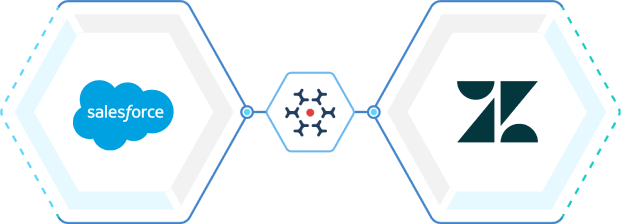
Give end-to-end traceability to sales and support teams with OIM’s two-way sync.


The Power of Integrated Sales and Support
When sales and support work together seamlessly, your customers win. A reliable Salesforce Zendesk integration ensures that both teams have a unified view of customer data-enabling better conversations, faster resolutions, and increased sales.
Leverage data to provide tailored support experiences by equipping agents with a unified view of customer information. With integration, your support teams using Zendesk have full visibility into the Salesforce customer profile (and vice versa) within their system.


Sync your business-critical data in minutes with OpsHub’s Enterprise-Grade Integration
Automatically synchronize tickets in Salesforce and Zendesk in real time – ensuring all information is up to date, consolidated, and easily accessible for better decision-making and service delivery.
Effortlessly create and track Zendesk incidents directly from Salesforce (and vice versa) without leaving your preferred platform. This enables teams to monitor progress and ensures that tickets are accurately linked to the correct customer or opportunity.
OIM is designed to keep enterprise needs at the forefront. The platform provides an easy-to-use, unified interface to monitor integration progress, minimize context churn, and keep all stakeholders in the loop – irrespective of your team size and project volume.
OIM enables sales reps to track customer support tickets, allowing them to step in when needed, while support agents can stay informed of any sales-related developments that impact a ticket.
Set up connection to Zendesk and Salesforce.
Select entities to be integrated.
Select sync direction and sync filter.
Click and map fields to be integrated.
Streamline communication and issue resolution between sales and support teams by synchronizing customer cases between Salesforce and Zendesk.
A sales representative in Salesforce receives a customer complaint or issue requiring support intervention.
The ticket in Salesforce is automatically synced with Zendesk, creating a corresponding ticket in Zendesk.
Key case details, including customer information, priority, product information, issue description, comments, and attachments, are transferred to Zendesk.
The sales team in Salesforce can flag a case as “critical” by adding a comment. This comment is synced to Zendesk as a hidden note, indicating the case’s urgency.
The Zendesk support team receives the ticket, assesses its priority, and assigns it to the appropriate agent. The ticket’s status is updated to “Active” in Zendesk and automatically reflected in Salesforce.
The Salesforce sales team can track the progress of the issue in real-time through their Salesforce case interface. Updates on support actions, resolutions, and status changes are synchronized between the two systems.
When the Zendesk support team resolves the issue, the ticket is closed. This status change is synced to Salesforce, automatically updating the Salesforce case to “Closed.”
Both teams are notified of the resolution. The sales team can follow up with the customer to gather feedback, explore upsell opportunities, or discuss renewal options.
Sales reps use Salesforce Zendesk sync to view, create, and edit Zendesk tickets directly from Salesforce, keeping support and sales teams aligned.
Both sales and support teams have access to real-time, consistent customer data, improving communication and customer experience.
Automate ticket routing and assignment based on customer information.
OIM is designed to handle large volumes of data and complex workflows without sacrificing performance. The platform requires minimal administration and provides detailed documentation + support to ensure your teams extract maximum value.
OIM offers a centralized, easy-to-use dashboard with detailed logging and monitoring features, allowing you to track every interaction and data transfer between Salesforce and Zendesk. This is essential for auditing compliance and ensuring data integrity.
With OIM – you not only sync data, but also understand the true context behind your data. It supports syncing links, attachments, comments, mentions, in-line content with history, as well as comes with built-in failure recovery + conflict resolution.
Integrations are built with OIM security features, including encryption, role-based access controls and compliance with industry standards such as SOC 2. This level of security is critical for protecting sensitive customer data.
OpsHub’s error handling features enhance the reliability of integration by ensuring that errors are managed smoothly without data loss or system downtime.
Better Resource
Utilization
Increase in Customer Satisfaction
0%Growth in SLA Turnaround Time
0%