OpsHub Integration Manager

No-code integration platform for rich bi-directional sync

OpsHub Migration Manager

Zero downtime migration to tool of your choice
OpsHub Archive Manager

Keep Historical Data, Without Slowing Down Your Tools

OpsHub Migrator for Microsoft Azure DevOps

Migrate or restructure Azure DevOps

OpsHub Data Bridge

Real-time, context-rich data lake for AI or analytics

Discover our story, vision, and impact.

By Domain

Software Development & Agile Engineering

No-code integration across teams and systems

IT Service Management & Customer Support

Enable collaboration between IT, support, and business teams

Product Lifecycle Management & Systems Engineering

Connect PLM & engineering teams for smarter products

Requirements Management for Regulated Industries

Ensure regulatory compliance from start to release

Blogs

Explore the latest in technology best practices

Case Studies

Success stories from the field

White Papers

Actionable insights for your business challenges.

Videos

See solutions in action

EBooks

Learn, plan, and execute with confidence

Press Releases

Official announcements and updates

Webinars

Join discussions that drive results

News Letters

Stay ahead with curated insights

Bridge the Gap Between Internal Teams and External Partners

Whether it's change requests, specs, or quality feedback — real supplier–vendor alignment needs more than emails and file shares. Connect systems across organizational boundaries without compromising control or traceability.

Sign Up for a Free Trial!

Why Supplier–Vendor Integration is Hard (and Essential)

A 2024 BCG survey found 58% of enterprises failed at least one audit checkpoint due to lack of cross-system traceability with external partners.

Modern product development is no longer confined within enterprise walls. From Tier 1 suppliers to contract manufacturers and downstream software vendors, collaboration is continuous. Yet, most enterprises still rely on emails, portals, or one-way exports for collaboration — creating version drift, delayed updates, and zero audit trails.

This isn’t just inefficient. It’s a compliance and delivery risk.

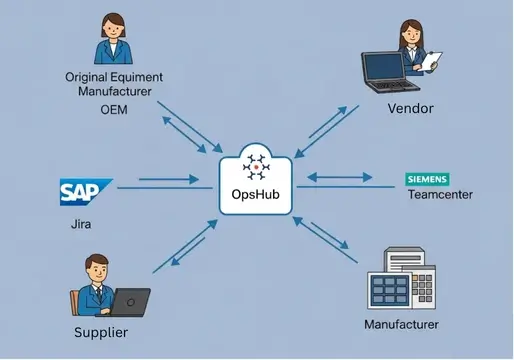
Whether your supplier uses the same tool (like Jira or Windchill) as your team or a completely different system, OpsHub Integration Manager ensures structured, secure, and lifecycle-aware collaboration — without requiring shared accessor manual workarounds.

Why Supplier Collaboration Breaks at the Enterprise Scale

Contractual Isolation vs. Operational Continuity

Suppliers operate in sandboxed environments. But requirements, test results and design changes must still flow both ways — without violating commercial boundaries or IP clauses.

Loss of Lifecycle Context Across Systems

A defect logged by your supplier must be traceable to your original requirements. A change request from your team must reflect downstream impact in the supplier’s environment. Without lifecycle mapping, compliance collapses.

Inconsistent Processes and Data Fidelity

Even if both parties use the same tool (e.g., Jira or ADO), custom workflows, naming conventions, field logic, and artifact structures are rarely aligned. This creates friction, failed syncs, or worse — silent data loss.

Why the Most Regulated, High-Stakes Enterprises Choose OpsHub

Effective vendor-supplier collaboration requires more than just the simple sync provided by most tools give you sync.

OpsHub gives you control over what matters: data integrity, traceability, and delivery confidence.

Here’s how:

No Direct Access. No Plugin Risk.

Suppliers don’t need access to your environment — and you don’t need theirs. OpsHub connects over APIs and syncs only what is contractually agreed.

Contract-Aware, Field-Level Control

Define sync scope down to fields, statuses, comments, or attachments — respecting what’s in-scope, redacted, or frozen per project. 

Lifecycle Mapping, Not Just Field Sync

Map requirements ↔ defects ↔ tests ↔ change requests across two different lifecycles. Maintain end-to-end traceability, not just data movement.

Conflict-Resistant Logic

OpsHub detects collisions, preserves original workflows, and avoids overwrite errors even when timelines or processes differ on both ends.

Role-Based Access, Fully Auditable

Ensure every transaction is logged, traceable, and audit-ready — supporting ISO, FDA, ITAR, or customer-specific validation protocols.

Scales Across Multi-Tier Supply Chains

Onboard multiple vendors, each with distinct systems, workflows, and access policies. Standardize governance without reimplementation.

Trusted by forward-thinking teams across the globe

Don’t Just Exchange Data — Govern It

With OpsHub, supplier collaboration becomes a strategic advantage — enabling agility, compliance, and transparency across your extended enterprise.