The Coming Divide in Defense: Federation or Fallout Under DoDI 5000.97
Share: The defense industry is entering a pivotal phase of transformation. With the release of DoDI 5000.97, the U.S. Department of Defense (DoD) has made


No-code integration platform for rich bi-directional sync

Zero downtime migration to tool of your choice
Keep Historical Data, Without Slowing Down Your Tools

Migrate or restructure Azure DevOps

Real-time, context-rich data lake for AI or analytics
By Role
Accelerate delivery with clear insights

Accelerate delivery with clear insights

Transform smarter with a connected digital thread

Confident transitions for every enterprise change
By Initiative

Operational readiness through connected engineering

Modernize and move to cloud without disruption

Build a compliant digital thread for complex environments

Build the foundation for smarter AI
By Domain

No-code integration across teams and systems

Enable collaboration between IT, support, and business teams

Connect PLM & engineering teams for smarter products

Ensure regulatory compliance from start to release

Explore the latest in technology best practices

Success stories from the field

Actionable insights for your business challenges.

See solutions in action

Learn, plan, and execute with confidence

Official announcements and updates

Join discussions that drive results

Stay ahead with curated insights
Share: The defense industry is entering a pivotal phase of transformation. With the release of DoDI 5000.97, the U.S. Department of Defense (DoD) has made
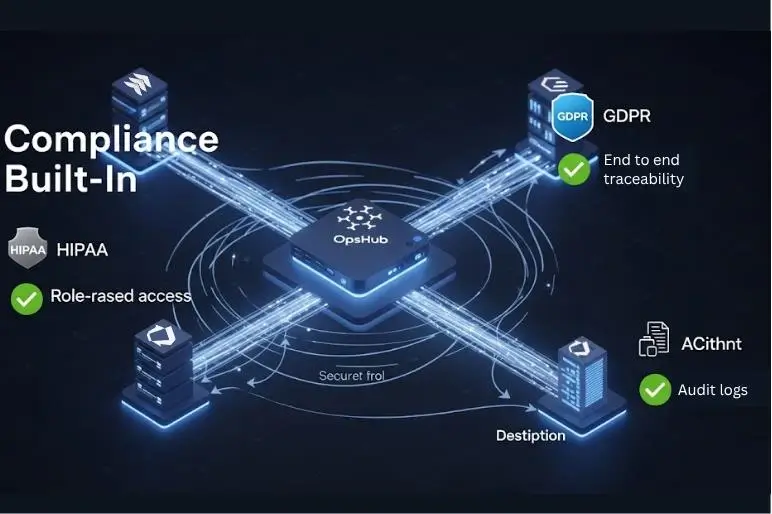
OpsHub connects your regulated toolchain — from requirements to releases — without altering end systems, workflows, or audit readiness.
Sign Up for a Free Trial!
In regulated industries, the scariest phrase in a boardroom isn’t “missed deadline” — it’s “failed audit.”
Requirements in one system. Test cases in another. Risk matrices nowhere to be found. And when the auditor asks for end-to-end traceability, the answer is nowhere to be found.
In life sciences, this can mean delayed FDA approvals. In aerospace and defense, it can cost you your next contract. Why is this happening?
Because most organizations still treat integration as an afterthought — something that gets duct-taped on after the tools are selected, the processes are live, and the stakeholders are already misaligned.
Audits demand traceability — not just data. But when your systems don’t sync, critical context gets lost: who approved what, when was a requirement changed, which version was tested.
No context = no compliance.
In regulated environments, you can’t just plug in a connector, install a plugin, or run scripts. Validated systems are locked down for a reason.
Any integration that alters end tools risks invalidation — and that’s a showstopper.
Your QA lead is copying Jira IDs into Excel. Your compliance team is building PowerPoint trace matrices by hand.
This isn’t “collaboration.” It’s a clumsy workaround economy — and it’s burning time, budget, and trust.
No Field Loss. No Data Drift. No Reconciliation Headaches.
In regulated environments, even a minor mismatch (e.g., “Status = Approved” syncing as “Done”) can void a test cycle or trigger revalidation.
Here’s how OpsHub solves it:
Most teams find out too late that their systems can’t explain what changed — or why. Let’s change that.